


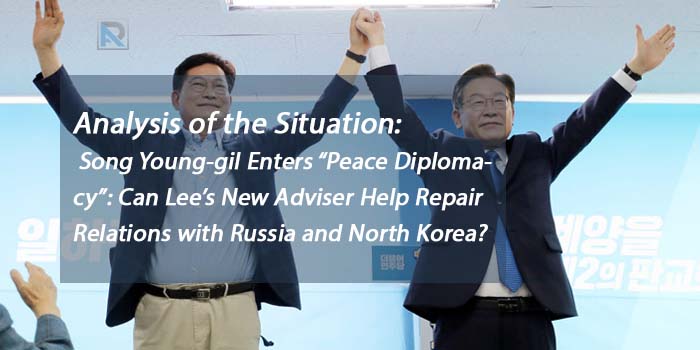
Analysis of the Situation: Song Young-gil Enters “Peace Diplomacy”: Can Lee’s New Adviser Help Repair Relations with Russia and North Korea?
(Executive Summary)
October 5th, 2026
South Korean President Lee Jae Myung’s appointment of veteran politician Song Young-gil as Special Presidential Adviser for Peace Diplomacy on October 1 deserves more attention than an ordinary personnel decision. Song is a six-term lawmaker, former leader of the Democratic Party, former mayor of Incheon and one of the South Korean political figures best known in Russia. His appointment comes as Seoul faces two conspicuously difficult foreign-policy fronts: relations with Russia remain largely frozen, while North Korea continues to reject the Lee administration’s repeated attempts to reopen inter-Korean dialogue. Song’s background, Russian connections and longstanding interest in linking relations with Moscow to Korean Peninsula diplomacy suggest that the new position could be used to explore channels that conventional diplomacy has so far failed to open. This remains a hypothesis rather than an announced presidential strategy.
Two Foreign-Policy Fronts Where Seoul Has Made Little Progress
The appointment stands out against the broader record of the Lee administration. During its first year in office, Seoul has managed relations with Washington despite the unpredictability of Donald Trump, avoided renewed confrontation with Japan, expanded cooperation with Tokyo, maintained constructive ties with China and intensified engagement with Southeast and Central Asia. Russia and North Korea are the two major exceptions.
Relations with Moscow remain effectively frozen. Expectations in Russia that Lee’s presidency might end the particularly cold period associated with the previous administration have not produced a meaningful normalization. The fundamental constraints remain unchanged: the war in Ukraine, Russia’s military and political alignment with North Korea, South Korean sanctions, Seoul’s alliance with Washington and its cooperation with NATO. Lee therefore has considerably less room for maneuver toward Moscow than might have appeared before he took office.
The North Korean problem is even more difficult, although for different reasons. Lee has repeatedly signaled a desire to reduce confrontation, restore communication, promote peaceful coexistence and facilitate renewed US–North Korean diplomacy, potentially with Seoul acting as a “pacemaker.” Yet Pyongyang has consistently rejected South Korean overtures. Even after a recent mine explosion injured three South Korean soldiers in the DMZ, Lee deliberately avoided escalating his rhetoric and again emphasized patience, tension reduction and dialogue. The contrast is striking: Seoul is signaling its willingness to talk, while Pyongyang continues to refuse engagement.
Song therefore enters the administration at a moment when Seoul has frozen relations with Moscow on one side and a closed door in Pyongyang on the other.
Why Song Young-gil?
Song’s political résumé makes him unusually suited to an unconventional diplomatic role. He entered national politics during the Kim Dae-jung era, was first elected to the National Assembly in 2000 and has now won six parliamentary terms. He has served as mayor of Incheon, chairman of the National Assembly’s Foreign Affairs and Unification Committee and leader of the Democratic Party. Under President Moon Jae-in, he was dispatched to Moscow as a special presidential envoy and later became the first chairman of the Presidential Committee on Northern Economic Cooperation, which focused on Russia, the CIS and Eurasia.
His career suffered a major interruption during the so-called “cash envelope” scandal: Song left the Democratic Party, was investigated and spent roughly a year in detention. In February 2026, however, an appellate court fully acquitted him, prosecutors declined a further appeal, and he subsequently returned to the Democratic Party and won another National Assembly seat in the June by-election. His political rehabilitation therefore preceded his appointment as presidential adviser by only a few months.
For the present appointment, however, Song’s most relevant asset is his unusually extensive Russian network. He has visited Russia repeatedly and has been involved in Russian–South Korean relations since his time as mayor of Incheon. As Moon Jae-in’s special envoy in May 2017, he met Vladimir Putin in the Kremlin and delivered a personal message from the newly elected South Korean president. His subsequent work on northern economic cooperation further expanded his contacts among Russian political, business and expert circles. Unlike most current South Korean politicians, Song would not have to begin building a relationship with Moscow from scratch.
There is also a symbolic history to these ties. As mayor of Incheon, Song helped arrange the temporary return to Russia for exhibition of the historic flag of the cruiser Varyag, preserved in the Incheon Metropolitan City Museum. Incheon subsequently established a St. Petersburg Square and a memorial to the Varyag and the gunboat Koreets. Such episodes do not themselves constitute diplomatic leverage, but they illustrate the depth and longevity of Song’s engagement with Russia.
Russia and North Korea Have Long Been Connected in Song’s Thinking
Song has previously viewed Russia not merely as a bilateral partner but as a potential component of diplomacy toward North Korea. Before traveling to Moscow as Moon’s special envoy in 2017, he described Russia as an “important key” to resolving the North Korean nuclear issue. During his meeting with Putin, he explicitly asked whether Moscow might play a mediating role and send an envoy to North Korea to clarify Kim Jong Un’s position.
An even more revealing episode followed in 2018. Song led a South Korean delegation to North Korea’s Rason Special Economic Zone, traveling via Vladivostok and Khasan and crossing the Russian–North Korean border by special train. The central subject was the Khasan–Rajin project and the broader possibility of trilateral economic cooperation among Russia, North Korea and South Korea. Song was therefore already working with a Seoul–Moscow–Pyongyang diplomatic and economic configuration years before his current appointment.
This history matters because his first statements after becoming peace diplomacy adviser again combined the same two themes. Song said he intended to strengthen communication with the United States, China, Russia and Japan while helping recreate space for inter-Korean dialogue. Russia’s explicit inclusion among the traditional “four major powers” surrounding the Korean Peninsula is notable at a time when Moscow has sometimes effectively disappeared from Seoul’s immediate diplomatic priorities. The wording should not be overinterpreted, but coming from Song in his new position it provides a concrete reason to watch the Russian dimension of his work.
A Politician Who May Have Lee Jae Myung’s Personal Trust
Another important element is Song’s relationship with President Lee. There is no publicly demonstrated special arrangement between the two men, but their political history provides substantial circumstantial evidence of trust.
After Lee narrowly lost the 2022 presidential election, Song gave up his safe parliamentary constituency in Incheon’s Gyeyang district to run an extremely difficult mayoral race in Seoul. Song lost, but the vacant parliamentary seat was subsequently won by Lee, allowing him to return rapidly to institutional politics after his presidential defeat. Four years later, following his own political rehabilitation, Song again declined to fight for his former Gyeyang constituency when a close Lee ally sought the nomination, instead contesting a riskier district and nevertheless winning.
The relationship became more visible after the June 2026 by-elections. On June 18, immediately after Lee returned from a European tour, Song visited the presidential residence in Hannam for a private dinner. Song’s representative described their relationship as sufficiently longstanding that the two could meet without a special occasion. Taken together, these episodes do not prove that Song is a personal emissary in every substantive sense, but they strengthen the case that he enjoys meaningful access to and trust from the president.
That is particularly important for informal diplomacy. An intermediary carrying sensitive messages is useful only if foreign counterparts believe that he has genuine access to the head of state and can speak with some authority. Song’s combination of Russian contacts and apparent presidential trust could therefore make him more valuable as an unofficial channel than his formal title alone suggests.
Could Moscow Become an Additional Route to Pyongyang?
The most intriguing possibility is that Song’s Russian role could serve two purposes simultaneously: reopening some degree of communication with Moscow and, eventually, providing Seoul with an indirect channel to Pyongyang.
There is currently no evidence that President Lee has instructed Song to contact North Korea through Russia, and there is no evidence that Moscow has agreed—or would agree—to act as an intermediary. Any such interpretation must therefore remain explicitly hypothetical. Nevertheless, several factors make the scenario plausible enough to monitor. Song lacks a known direct channel to the current North Korean leadership but has longstanding contacts in Russia. Moscow, meanwhile, now enjoys a much closer relationship with Pyongyang than it did during Song’s earlier work on trilateral cooperation. Most importantly, Song himself has previously advocated using Russia as a channel in Korean Peninsula diplomacy.
A realistic first stage would not require formal Russian mediation. Song could attempt to re-establish working-level political contacts in Moscow, assess Russia’s view of the Lee administration and determine whether any space exists for partial normalization. Only after such contacts were established might Seoul explore whether Russia could transmit messages, clarify North Korean positions or identify conditions under which Pyongyang might consider some form of communication with the South. In diplomacy, the ability to send and receive a reliable signal can matter even when formal mediation is impossible.
Russia’s Influence Should Not Be Exaggerated
This scenario has clear limits. Contemporary North Korea is not a state that Moscow can simply persuade to change course at Seoul’s request. Pyongyang independently determines its strategy, and its policy toward South Korea has hardened substantially since it formally redefined the South as a separate hostile state and repeatedly rejected the idea of renewed inter-Korean engagement. Close Russian–North Korean relations therefore do not mean that Moscow can bring Kim Jong Un back to negotiations. Nor is it certain that Russia would even wish to attempt this.
The distinction between mediation and communication is consequently crucial. Expecting Moscow to persuade Pyongyang to reverse its policy would be unrealistic. Using Russian contacts simply to transmit a signal, test North Korean reactions or establish what conditions might be required for future communication is a considerably more modest—and more plausible—objective.
What to Watch Next
Song’s appointment is significant not because one adviser can resolve the structural problems in South Korea’s relations with Russia or North Korea. He cannot remove the disagreements generated by the Ukraine war, sanctions, Russia–North Korea military cooperation or Seoul’s alliance structure. Nor can his diplomatic skills alone alter Pyongyang’s current strategy.
Its significance lies instead in the possibility that Lee has chosen someone capable of operating where formal diplomacy has produced few results. Song knows Russia; Russian political circles know him. He has negotiated at senior levels, worked on projects involving all three countries and has previously treated Moscow as a potential channel for Korean Peninsula diplomacy. He also appears to possess the personal political access necessary for sensitive informal contacts.
The appointment therefore creates several concrete indicators to watch:
- A visit to Moscow. Whether Song travels to Russia—and whether such a trip is highly publicized or deliberately low-key—would be the clearest early indication that the Russian component of his mandate is becoming operational.
- The level of his Russian interlocutors. Meetings with senior Kremlin, Foreign Ministry or other influential political figures would indicate that Moscow is willing to treat him as a meaningful presidential channel rather than merely another visiting South Korean politician.
- Signs of partial Russia–South Korea normalization. Even modest steps—restored political consultations, new unofficial contacts or renewed discussion of non-sanctioned cooperation—would suggest that Song is attempting to break the current diplomatic freeze.
- Subsequent initiatives toward North Korea. If renewed Russian contacts are followed by new South Korean proposals, indirect messages or references to Russian assistance in communicating with Pyongyang, the hypothesis of a Moscow channel would become substantially stronger.
- North Korean reaction. Pyongyang’s response would ultimately be decisive. Continued categorical rejection would show the limits of any indirect channel regardless of Song’s relationship with Moscow.
The central analytical question is therefore not whether Song Young-gil can “solve” South Korea’s Russia and North Korea problems. He almost certainly cannot. The more realistic question is whether he can create channels where Seoul currently has few or none.
Song Young-gil’s appointment may represent an attempt by Lee Jae Myung to supplement conventional diplomacy with a politically trusted figure who combines presidential access, extensive Russian connections and previous experience linking Moscow to Korean Peninsula diplomacy. A breakthrough with either Russia or North Korea remains unlikely in the near term. But if Song begins working actively on both tracks—particularly if a Moscow visit is followed by attempts to transmit signals to Pyongyang—it would suggest that the seemingly broad title of “Special Presidential Adviser for Peace Diplomacy” conceals a more specific and potentially consequential mission.
Oleg Kiryanov
※ The views and opinions expressed here are solely those of the author and do not necessarily reflect the official position of the Asia Risk Research Center.
Editor's note: This is an abridged English summary of an article originally published in Russian. The full Russian version is available on the Asia Risk Research Center website.

