


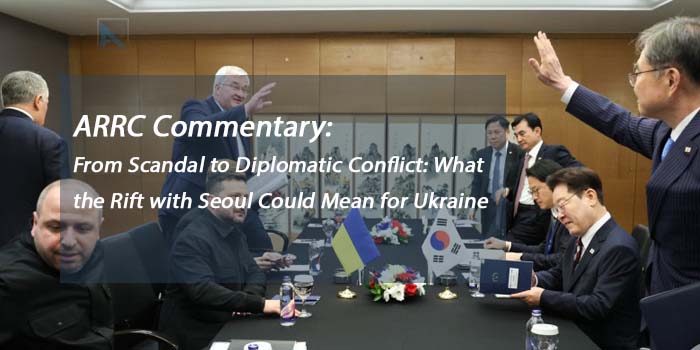
ARRC Commentary: From Scandal to Diplomatic Conflict: What the Rift with Seoul Could Mean for Ukraine
(Executive Summary)
October 5th, 2026
A dispute over two North Korean soldiers captured by Ukraine and subsequently transferred to South Korea has escalated from a relatively contained diplomatic misunderstanding into a serious bilateral conflict between Seoul and Kyiv. The immediate trigger was Ukrainian President Volodymyr Zelensky’s public disclosure at the UN General Assembly that the soldiers had been transferred to South Korea, despite what Seoul says was a clear agreement to keep the transfer confidential. The confrontation intensified after Ukrainian officials denied that such an agreement had existed. South Korean President Lee Jae Myung has since demanded a public acknowledgment and apology and warned of possible “additional measures.”
The dispute is therefore no longer primarily about the disclosure itself. For Seoul, it has become a question of trust and the credibility of confidential understandings between governments. South Korea’s National Intelligence Service told lawmakers that the request for secrecy had originally come from Ukraine and had subsequently been reaffirmed through several diplomatic channels. If Seoul’s account is accurate, Kyiv’s later denial transformed a breach of confidentiality into a challenge to the South Korean government’s credibility and, ultimately, to President Lee personally.
Why Zelensky chose to disclose the transfer remains unclear. One possibility is poor coordination within the Ukrainian government or insufficient awareness of working-level arrangements. Another is that Kyiv deliberately concluded that the political value of publicizing the case outweighed the confidentiality commitment. South Korean intelligence has suggested that Zelensky may have sought to focus Korean public attention on North Korea’s involvement in the Russia-Ukraine conflict and thereby strengthen the case for greater South Korean support, potentially including weapons. This remains an assessment rather than an established motive. If that was indeed Kyiv’s objective, however, the result may have been the opposite of what was intended.
The conflict also exposes a deeper divergence between Seoul and Kyiv over North Korea. Ukraine primarily views Pyongyang through the prism of its military cooperation with Russia and has an interest in emphasizing the security threat this poses to South Korea. The Lee administration, by contrast, combines military deterrence and modernization with an effort to reduce inter-Korean tensions and reopen channels of communication with Pyongyang. Statements portraying a future inter-Korean military confrontation as increasingly likely may therefore be counterproductive in Seoul, where they can be seen as imposing Ukraine’s strategic logic on the Korean Peninsula.
The dispute has now moved beyond a diplomatic scandal and is best described as a diplomatic conflict, but not yet a full bilateral crisis. Ambassadors remain in place, diplomatic contacts continue, and the two foreign ministers are actively seeking a formula for resolving the dispute. A crisis would become more likely if Kyiv refused Seoul’s demand for acknowledgment and an apology and South Korea proceeded with the “additional measures” threatened by President Lee.
The most important potential consequence concerns military cooperation rather than humanitarian or economic assistance. South Korea is unlikely to terminate humanitarian support for Ukraine, and normal diplomatic relations will probably continue once the immediate dispute is settled. Direct South Korean deliveries of lethal weapons to Ukraine were already politically sensitive, however, and more complex indirect arrangements would require a particularly high degree of political trust and confidentiality. The current dispute has raised the political cost of such decisions and narrowed the space for sensitive or unofficial arrangements.
The most likely outcome is therefore neither a rupture in relations nor an indefinite confrontation. Seoul and Kyiv will probably eventually find a formula that allows Ukraine to express regret or apologize without appearing to capitulate, while giving President Lee sufficient grounds to declare the matter resolved. Yet resolving the dispute and restoring trust are not the same thing. The longer-term damage may emerge later, when Kyiv again seeks sensitive cooperation from Seoul—particularly arms supplies or arrangements affecting South Korea’s relations with Russia or North Korea. In such circumstances, the precedent created by this episode is likely to remain part of Seoul’s calculations.
The immediate South Korea–Ukraine dispute will probably be contained, but the breach of trust may have lasting consequences in precisely the area where Ukraine has the greatest interest in expanding cooperation with Seoul: defense and politically sensitive military assistance.
Oleg Kiryanov
※ The views and opinions expressed here are solely those of the author and do not necessarily reflect the official position of the Asia Risk Research Center.
Editor's note: This is an abridged English summary of an article originally published in Russian. The full Russian version is available on the Asia Risk Research Center website.

