


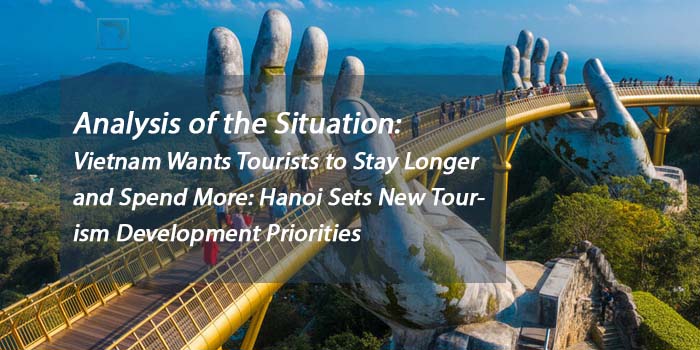
Analysis of the Situation: Vietnam Wants Tourists to Stay Longer and Spend More: Hanoi Sets New Tourism Development Priorities
September 15th, 2026
(Executive Summary)
Vietnam is preparing for a major transformation of its tourism industry, aiming not only to more than double the number of international visitors by 2030 but also to significantly increase the economic value generated by each tourist. The new strategy combines aggressive growth in visitor numbers with a shift toward higher-spending travelers, longer stays, premium tourism products and a more flexible visa regime.
The new priorities are set out in Resolution No. 26 of the Politburo of the Communist Party of Vietnam, signed by General Secretary and President To Lam on August 22 and published in full on August 28. The document identifies tourism as a future leading sector of the national economy while acknowledging that Vietnam has so far failed to fully capitalize on its considerable tourism potential. Among the weaknesses identified are relatively low value added, insufficiently distinctive tourism products, uneven service quality, weak coordination between regions and the slow adoption of modern technologies.
The central principle of the new strategy is a transition “from quantity to quality.” However, Hanoi is not abandoning mass tourism. On the contrary, it intends to pursue both quantity and quality simultaneously. Vietnam welcomed almost 21.2 million international visitors in 2025. By 2030, the government wants to increase this figure to 45–50 million annually, while domestic tourism is expected to reach 160 million trips per year. At the same time, Vietnam intends to prioritize visitors who spend more and remain in the country for longer periods.
The economic targets are equally ambitious. By 2030, total tourism revenue is expected to reach USD 80–90 billion annually, with the sector contributing directly 10–12 percent of GDP. Looking further ahead, Vietnam aims to attract 70 million international visitors a year by 2045, increase tourism’s direct contribution to 14–15 percent of GDP and enter the group of the world’s 30 most competitive tourism destinations.
Achieving these targets will require a substantial change in the country’s tourism product. Traditional beach and cultural tourism will remain important, but the authorities increasingly want to develop segments associated with higher visitor spending. Premium coastal and island resorts, yacht tourism and international cruises are among the priorities. Vietnam plans to develop ports and terminals capable of receiving large cruise ships and strengthen its position in the rapidly expanding Asian cruise market.
Medical and wellness tourism is another major target. Around 300,000 foreign visitors are already estimated to use medical services in Vietnam each year, generating approximately USD 1–2 billion in combined expenditure on treatment, accommodation, transportation and food. The government now wants to develop this sector systematically, combining modern healthcare with traditional medicine, dentistry, aesthetic procedures, rehabilitation, wellness services and resort tourism.
Sports tourism is also expected to become a more significant component of the industry. The strategy identifies golf, marathons, water sports, mountaineering, paragliding and extreme sports as promising areas, while major sporting competitions are to be promoted as tourism events in their own right. In parallel, Hanoi intends to expand MICE tourism — meetings, incentives, conferences and exhibitions — as another way of attracting affluent international visitors and business travelers.
A particularly important objective is to increase tourist spending outside hotels and transportation. Vietnam therefore intends to expand its “night-time economy,” including restaurants, entertainment and shopping streets, night markets, concerts, festivals and large entertainment complexes. International-standard outlet centers, duty-free shopping and improved VAT-refund mechanisms for foreign visitors are also envisaged. The underlying idea is to turn shopping, entertainment and leisure activities into major independent sources of tourism revenue rather than treating them as secondary services.
Visa policy is expected to support this shift. The Politburo has called for further expansion of reciprocal visa-free arrangements and more flexible visa incentives for markets considered particularly promising for Vietnamese tourism. The government will also examine special preferential visa mechanisms for high-spending foreign visitors. Although the precise criteria have yet to be determined, the strategic principle is clear: immigration policy should increasingly be used as an economic instrument to attract categories of visitors that provide the greatest value to the tourism industry.
Vietnam is also considering measures aimed at foreigners who wish to stay significantly longer than conventional tourists. The authorities have been instructed to explore pilot mechanisms for attracting long-term foreign residents and remote workers. This effectively signals Vietnam’s intention to compete for the growing Asian market of digital nomads, expatriates and internationally mobile professionals rather than focusing exclusively on short-term holidaymakers.
Geographically, the new tourism economy will be organized around three principal growth poles — Hanoi, Ho Chi Minh City and Da Nang — supplemented by ten major tourism centers and twenty national tourism zones. Phu Quoc Island will receive particular attention as an international premium coastal destination and a venue for major international events.
The strategy also seeks to strengthen Vietnam’s domestic tourism industry rather than relying predominantly on international operators. By 2030, the country plans to develop 15 large Vietnamese tourism groups and corporations with internationally competitive brands. These companies are expected to operate across hotels and resorts, travel services, destination management and related sectors. This will be accompanied by substantial investment in transport and tourism infrastructure, including better road connections between airports and resorts, tourist rail services, river transportation, cruise terminals and yacht marinas.
Vietnam’s new model therefore represents more than a conventional campaign to attract additional foreign visitors. Hanoi wants to change the economics of tourism itself. Success will increasingly be measured not simply by how many foreigners enter the country, but by how long they remain and how much they spend on accommodation, restaurants, shopping, healthcare, entertainment and other services. The objective is not to replace mass tourism with luxury tourism, but to make rapidly expanding mass tourism considerably more profitable.
This approach has parallels with the transformation currently under way in neighboring Thailand, one of Vietnam’s main competitors for international tourists in Southeast Asia. Bangkok has adopted the principle of “Value over Volume,” seeking wealthier visitors, longer stays and further development of medical, wellness, sports and premium tourism. There is, however, an important difference. While Thailand has simultaneously tightened some rules governing foreigners’ stays, Vietnam is moving toward further visa liberalization. The article notes that this difference is already contributing to a shift among some Western expatriates toward Vietnam, attracted by lower costs, easier visa conditions and what they regard as a more welcoming environment.
If Hanoi succeeds, Vietnam could enter the next decade not merely as one of Southeast Asia’s fastest-growing mass-tourism destinations, but as a substantially more diversified tourism economy capable of extracting much greater value from each visitor. The key challenge will be whether infrastructure, service standards, human resources and institutional coordination can develop quickly enough to accommodate a potential doubling of international arrivals while simultaneously delivering the higher-quality experience on which the entire strategy depends.
Oleg Kiryanov
※ The views and opinions expressed here are solely those of the author and do not necessarily reflect the official position of the Asia Risk Research Center.
Editor's note: This is an abridged English summary of an article originally published in Russian. The full Russian version is available on the Asia Risk Research Center website.

