


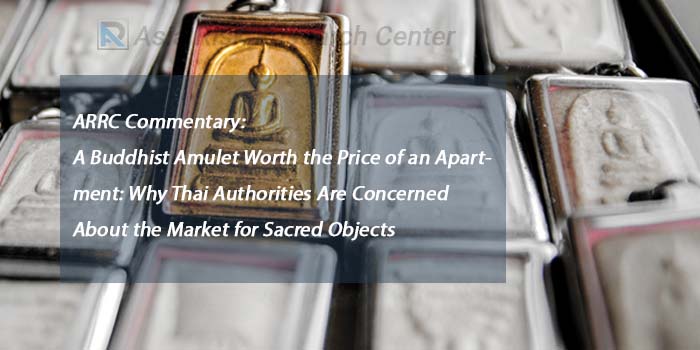
ARRC Commentary: A Buddhist Amulet Worth the Price of an Apartment: Why Thai Authorities Are Concerned About the Market for Sacred Objects
September 2nd, 2026
(Executive Summary)
Thailand’s authorities have drawn renewed attention to one of the country’s most unusual markets — the trade in Buddhist amulets, where religious objects can sell for millions of baht and increasingly function not only as sacred items and collectibles, but also as investment assets.
On June 22, 2026, Thailand’s National Anti-Corruption Commission (NACC) announced stricter requirements for politicians and public officials declaring valuable Buddhist amulets and works of art. Officials will now be required to declare each valuable item separately, provide high-resolution photographs and document its origin or substantiate its stated value. According to the NACC, the measures are intended to prevent such assets from being used to conceal illegally acquired wealth.
The decision highlights a phenomenon that may seem unusual to outsiders. In Thailand, Buddhist amulets are far more than inexpensive religious souvenirs. Over decades, a sophisticated market has developed around them, combining religious devotion, collecting, investment and speculation. In economic terms, its structure increasingly resembles the markets for art, antiques or rare coins.
Thai Buddhist amulets are usually small plaques, medallions or figurines depicting the Buddha, prominent monks, bodhisattvas or other revered figures. They may be made from bronze, silver, gold, clay, ceramics, wood, stone or special powdered compounds. After production, they are blessed in religious ceremonies. Many Thais wear them around their necks, believing that they can provide protection, bring good fortune and serve as a reminder of Buddhist moral principles. For believers, therefore, an amulet remains first and foremost a sacred object.
Most newly issued amulets are not expensive. Temples traditionally distribute them in exchange for donations, often to raise funds for restoration projects, religious events, education and charitable activities. Their economic value can change dramatically, however, once they enter the secondary market.
An amulet associated with a particularly revered monk, an important temple or a limited production series may increase in value tens, hundreds or even thousands of times. The most prestigious category includes the so-called Benja Phakhi, five legendary types of Thai Buddhist amulets regarded as the pinnacle of the collecting market. Authentic examples can be valued at more than 10 million baht, with particularly rare specimens commanding even higher prices.
Prices are determined by factors familiar from other collectible markets: age, rarity, provenance, the temple of origin, the monk who produced or blessed the object, its physical condition and expert authentication. Thailand consequently has an entire professional infrastructure surrounding the trade. Bangkok’s Tha Phrachan area, near Thammasat University and the Grand Palace, is one of the best-known centers. Specialist dealers, appraisers, catalogues, magazines, exhibitions, competitions and auctions serve collectors, while valuable pieces are subjected to detailed examination because counterfeiting is widespread.
The structure of the market also means that temples are not necessarily the main beneficiaries of rising prices. A monastery receives money when an amulet is initially distributed in exchange for a donation. Subsequent appreciation, however, benefits private owners, dealers, intermediaries and professional collectors. In this respect, the market operates much like the art market: the original creator or institution receives the proceeds from the first transaction, while later resales can take place at dramatically higher prices.
This is also where the concerns of Thai authorities become more significant. Some amulets are increasingly promoted not primarily for their religious significance but as assets expected to appreciate in value. Buyers may therefore enter the market hoping to profit from future price increases rather than for reasons of faith or collecting.
Thailand has experienced such speculative enthusiasm before. In the mid-2000s, Jatukham Rammathep amulets became the center of a nationwide craze. Hundreds of series were produced and, according to estimates cited by Thai media, the market reached approximately 20 billion baht. Buyers queued to acquire new issues in the expectation that they could quickly resell them at higher prices. When supply eventually overwhelmed demand, prices fell sharply and many speculative buyers suffered losses.
The current debate therefore goes beyond religion. Prominent Thai monks have repeatedly warned against reducing sacred objects to instruments of financial speculation, arguing that an amulet’s primary value lies in its spiritual meaning rather than its market price. Yet the secondary market has developed its own economic logic.
For some Thais, Buddhist amulets remain sacred objects. For others, they are collectibles and elements of cultural heritage. For a growing number of market participants, they can also serve as alternative investments whose prices may rival those of an apartment or an expensive car.
This combination makes Thailand’s amulet market particularly unusual. It exists at the intersection of religion, cultural tradition and modern investment behavior. The authorities’ concern is therefore not directed at the Buddhist practice itself, but at the financial ecosystem that has developed around it — an ecosystem involving large sums of money, opaque valuations, opportunities to conceal wealth and the risk of speculative bubbles.
Oleg Kiryanov
※ The views and opinions expressed here are solely those of the author and do not necessarily reflect the official position of the Asia Risk Research Center.
Editor's note: This is an abridged English summary of an article originally published in Russian. The full Russian version is available on the Asia Risk Research Center website.

