


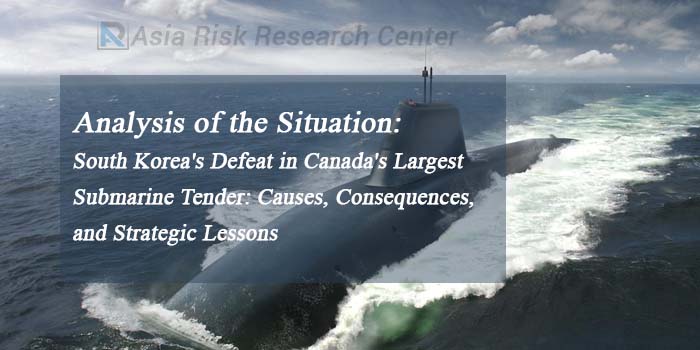
Analysis of the Situation: South Korea's Defeat in Canada's Largest Submarine Tender: Causes, Consequences, and Strategic Lessons
July 22nd, 2026
(Executive Summary)
South Korea suffered a significant setback in its efforts to expand its position in the global naval defense market after losing Canada's Canadian Patrol Submarine Project (CPSP), one of the world's largest conventional submarine procurement programs. Despite an extensive diplomatic campaign, broad industrial cooperation proposals, and a competitive technological offer, the South Korean consortium consisting of Hanwha Ocean and HD Hyundai Heavy Industries failed to secure preferred bidder status. Instead, Canada selected Germany's ThyssenKrupp Marine Systems (TKMS). The decision illustrates that large defense procurements are increasingly influenced not only by technical specifications and pricing but also by broader geopolitical considerations, alliance politics, industrial integration, and long-term strategic partnerships. While South Korea remains a highly competitive defense exporter, the Canadian outcome demonstrates that success in NATO markets increasingly depends on becoming part of the broader Western defense-industrial ecosystem rather than simply offering technologically advanced products.
Canada's Largest Naval Procurement Program
The Canadian Patrol Submarine Project, launched in 2021, is expected to cost between US$39 and 43 billion. The program aims to replace Canada's aging Victoria-class submarines with up to twelve modern conventional submarines while also establishing long-term maintenance and support infrastructure inside Canada.
Operational requirements were particularly demanding. The new submarines must conduct intelligence collection, surveillance, and patrol missions across the Atlantic, Pacific, and Arctic Oceans while remaining fully interoperable with NATO and Five Eyes standards. Additional requirements include Arctic operations, advanced sonar systems, long underwater endurance using air-independent propulsion, secure communications, extensive domestic industrial participation, and delivery of the first submarine by 2035.
Initially, several international designs competed for the contract, including submarines from Sweden, France, Spain, Japan, South Korea, and Germany. By August 2025, the competition had narrowed to South Korea's KSS-III Batch II and Germany's Type 212CD.
South Korea's Comprehensive Offer
South Korea presented far more than a submarine proposal.
Hanwha Ocean and HD Hyundai Heavy Industries offered a package valued at approximately US$20–24 billion, promising delivery of the first four submarines by 2035 together with maintenance facilities, training centers, technology transfer, and long-term support infrastructure inside Canada.
Over several years, South Korean companies systematically built partnerships with Canadian industry. More than eighty cooperation agreements were signed with Canadian firms covering defense technologies, logistics, shipbuilding, electronics, metallurgy, energy, batteries, and communications. Agreements were also reached with colleges to train Canadian shipbuilding personnel and with Ontario Shipyards to strengthen Canada's domestic naval industrial base.
The effort extended well beyond defense.
Seoul proposed broader economic cooperation involving automotive production, battery materials, critical minerals, liquefied natural gas, hydrogen transportation infrastructure, and energy security. South Korea also pledged to expand imports of Canadian crude oil and LNG while increasing investments in Canadian resource projects.
This transformed the submarine proposal into a comprehensive economic partnership rather than a simple defense procurement.
Why Germany Won
The Canadian decision resulted from a combination of technical, strategic, and economic considerations, although geopolitical factors ultimately proved decisive.
Technically, both submarines largely met Canadian operational requirements. However, Germany's Type 212CD was considered better suited for Canada's primary mission profile. The German submarine is smaller, quieter, and optimized for intelligence collection and anti-submarine warfare, whereas South Korea's larger KSS-III Batch II incorporates significant strike capabilities, including vertical launch systems for ballistic missiles, making stealth optimization relatively more difficult.
Strategically, Germany possessed a major advantage through alliance integration. The Type 212CD is jointly developed by Germany and Norway, allowing Canada to join an existing multinational logistics, maintenance, training, and operational framework already embedded within NATO. This interoperability significantly reduced long-term operational risks while strengthening Canada's broader integration with European defense structures.
Timing also played an important role. Germany and Norway agreed to adjust their own production schedules, enabling Canada to receive its first submarines earlier than originally expected.
Finally, Germany presented a larger industrial and economic package. TKMS promised broader technology transfer, deeper integration of Canadian companies into global supply chains, larger domestic industrial benefits, and greater job creation. According to Canadian estimates, the German proposal would generate approximately US$62 billion in economic benefits and around 650,000 jobs, exceeding the projected impact of the South Korean package. Prime Minister Mark Carney also emphasized that the full value of the contract would effectively be reinvested into Canada's economy.
Does South Korea Still Have Opportunities?
Although Germany has become the preferred bidder, South Korea has not been completely eliminated from the project.
Canada designated the Korean consortium as a reserve supplier, preserving the option of returning to the Korean proposal if negotiations with TKMS encounter serious difficulties before the anticipated contract signing in late 2027.
Some uncertainty also remains regarding procurement structure. Canada may eventually divide submarine construction into multiple production batches, potentially creating opportunities for additional suppliers. While such a scenario currently appears unlikely, it cannot yet be ruled out entirely.
Strategic Lessons for South Korea
The Canadian outcome represents more than an isolated commercial defeat.
During recent years South Korea has also failed to secure several other major naval contracts, including India's Project 75I submarine program, Poland's Orka program, Indonesia's submarine procurement, and Australia's frigate competition.
Taken together, these cases suggest broader structural challenges in Seoul's export strategy for large naval platforms.
South Korea's traditional strengths—competitive pricing, rapid production, and advanced technology—remain important but increasingly insufficient in highly political defense markets.
Future success, particularly within NATO countries, will likely require:
- deeper industrial integration with allied defense industries;
- expanded overseas maintenance and support infrastructure;
- greater participation in multinational defense programs;
- wider use of licensed and joint production;
- increased localization;
- broader technology transfer;
- closer strategic cooperation with NATO itself.
Such measures could reduce the political advantages currently enjoyed by established European manufacturers while making South Korean firms indispensable long-term partners rather than external suppliers.
Future Outlook
Despite the disappointment, the competition also demonstrated South Korea's growing capabilities.
The Korean consortium reached the final round after outperforming several established international competitors and competed closely with one of the world's leading submarine manufacturers. This experience strengthens South Korea's credibility in future international competitions.
Looking ahead, Seoul is expected to pursue two complementary strategies.
The first involves deeper integration with NATO's defense-industrial ecosystem, reflecting broader trends already visible in President Lee Jae Myung's recent proposals for expanded defense cooperation with the Alliance.
The second focuses on markets where political barriers may be lower and industrial cooperation more flexible. Southeast Asia, South America, and the Middle East appear particularly promising. Peru, the Philippines, Greece, Saudi Arabia, Egypt, Colombia, and Chile all represent potential future opportunities for South Korean submarine exports and broader naval-industrial cooperation.
Overall, the Canadian decision highlights a broader transformation in the international defense market. Technical excellence alone no longer guarantees success. Large defense contracts increasingly depend on long-term political alignment, industrial integration, and participation in allied defense ecosystems. For South Korea, adapting to this new reality will likely become the central challenge of its future defense export strategy.
Pavel Cherkashin
※ The views and opinions expressed here are solely those of the author and do not necessarily reflect the official position of the Asia Risk Research Center.
Editor's note: This is an abridged English summary of an article originally published in Russian. The full Russian version is available on the Asia Risk Research Center website.

О компании Asia Risk Research Center
Asia Risk Research Center специализируется на изучении общественно-политической и торгово-экономической ситуации в Восточной Азии, предоставлении консалтинговых услуг и аналитических исследований. География наших проектов охватывает обширный регион Восточной Азии, включая Корейский полуостров (Южная и Северная Корея), Китай, государства Юго-Восточной Азии (Вьетнам, Филиппины, Сингапур, Индонезия, Мьянма, Таиланд), Океании (Австралия, Новая Зеландия) и другие.
Главный фокус нашей работы сосредоточен на Корейском полуострове (как южной части – Республика Корея, так и северной - КНДР), однако мы также активно занимаемся вопросами, затрагивающими взаимоотношения этих государств с другими странами.
