


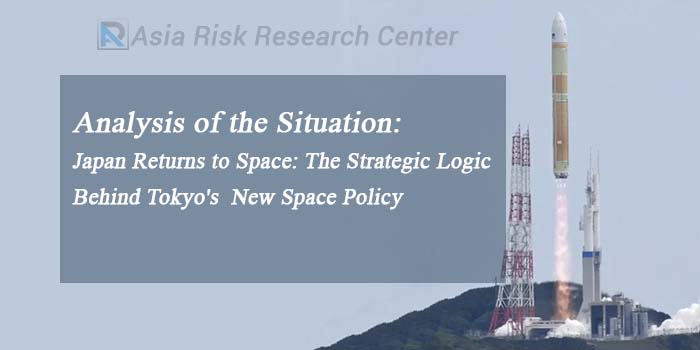
Analysis of the Situation: Japan Returns to Space: The Strategic Logic Behind Tokyo's New Space Policy
July 23rd, 2026
(Executive Summary)
Japan is undergoing the most significant transformation of its space policy in decades. While the successful July 2026 test of the experimental reusable rocket RV-X attracted international attention, the launch itself was only a visible symbol of a much broader strategic shift. Tokyo is no longer treating space primarily as a scientific endeavor. Instead, it is redefining space as a pillar of industrial policy, national security, technological competitiveness, and international influence.
Rather than attempting to compete directly with the United States or China in terms of launch frequency or overall scale, Japan is pursuing a different strategy: becoming a global leader in carefully selected high-value technological niches while integrating itself deeply into multinational space programs with trusted partners.
A Small Rocket Test That Signals a Major Strategic Shift
On 11 July 2026, Japan successfully tested the RV-X experimental rocket at the Noshiro Test Center. The vehicle ascended approximately 11 meters, translated laterally, and landed vertically after a 40-second flight.Technically, the flight was modest. Strategically, however, it represented an important milestone.
Developed jointly by JAXA and Mitsubishi Heavy Industries since 2016, RV-X is not intended to become Japan's version of SpaceX's Falcon 9. Instead, it serves as a technology demonstrator designed to validate key capabilities required for future reusable launch systems, including precision landing, reusable engines, flight control algorithms, and structural durability.
The project reflects Japan's recognition that reducing launch costs will be impossible without reusable technologies. Accordingly, RV-X represents only the first step in a much broader long-term modernization program.
From Scientific Exploration to a Space Economy
For decades, Japan's space program focused primarily on scientific missions and government-led projects.This model is now changing fundamentally.
According to Japan's updated Basic Plan on Space Policy, space is no longer viewed solely as an area of scientific research but simultaneously as:
- an engine of economic growth;
- an element of national security;
- a source of international technological competitiveness.
To implement this vision, Tokyo established the Space Strategy Fund, worth approximately ¥1 trillion (around US$6.5–7 billion) over ten years. Rather than financing JAXA itself, the fund supports universities, research institutions, and private companies developing space technologies.
Government spending also continues to increase. Japan allocated more than ¥1.04 trillion to space programs in fiscal year 2026, roughly 12 percent more than the previous year. The government's stated objective is to double the size of Japan's domestic space economy from approximately ¥4 trillion in 2020 to ¥8 trillion during the early 2030s.
These figures demonstrate that Tokyo is attempting to build not merely a stronger space agency but an entirely new high-technology industrial sector.
Private Industry Becomes a Central Driver
Perhaps the most important structural change is the growing role assigned to private companies.
Historically, Japan's space sector revolved around JAXA and large industrial conglomerates such as Mitsubishi Heavy Industries.
The new strategy seeks to establish a much broader commercial ecosystem.
Among its most prominent participants are:
- Honda, which successfully tested an experimental reusable rocket and is exploring launch technologies based on its expertise in engines, automation, and control systems;
- ispace, one of the world's most visible commercial lunar exploration companies despite setbacks during previous lunar landing attempts;
- Astroscale, an international leader in orbital debris removal and on-orbit satellite servicing;
- Synspective, specializing in radar Earth-observation satellites;
- Axelspace, focused on small satellites;
- ArkEdge Space, developing microsatellites;
- Infostellar, providing cloud-based satellite ground station networks.
Unlike the American model, which has become heavily centered around SpaceX, Japan aims to cultivate numerous highly specialized companies, each occupying a globally competitive niche.
The government's role is to create stable demand, finance critical technologies, and support an industrial ecosystem rather than rely on a single dominant private champion.
Space Becomes a National Security Domain
Another defining feature of Japan's new strategy is the growing integration of space into national defense planning.
Official documents increasingly describe space as an operational domain alongside land, sea, air, and cyberspace. This represents a notable departure from Japan's traditional emphasis on the exclusively peaceful character of its space activities.
Several developments have accelerated this shift. The war in Ukraine highlighted the military importance of commercial satellite communications, persistent satellite reconnaissance, and resilient orbital infrastructure. At the same time, Japanese planners increasingly view a potential Taiwan contingency as a scenario in which space assets would become primary military targets.
Consequently, Tokyo is expanding several defense-oriented capabilities:
- Space Domain Awareness systems to monitor satellites and orbital debris;
- resilient military satellite communications;
- larger Earth observation satellite constellations;
- rapid replacement of damaged satellites using smaller spacecraft and lower-cost launch systems.
As a result, commercial launch capabilities and national defense requirements increasingly reinforce one another.
The Lunar Dimension
Military considerations constitute only one component of Japan's broader ambitions. An equally important priority is participation in NASA's Artemis lunar exploration program.
Under the 2024 U.S.-Japan agreement, Japan will provide a pressurized lunar rover jointly developed by Toyota and JAXA. In return, the United States intends to allow two Japanese astronauts to land on the Moon.
This agreement represents an unprecedented level of trust. No country other than the United States has previously received such a significant operational role within America's lunar exploration program.
The rover itself is designed for approximately ten years of operation, making it an important component of NASA's long-term lunar infrastructure rather than a symbolic contribution.
International Partnerships Instead of Strategic Autarky
Unlike China, Japan has deliberately rejected the goal of complete strategic autonomy in space.Instead, Tokyo seeks deeper international integration.
JAXA is expanding cooperation with NASA, ESA, France's CNES, Germany's DLR, Australia, India, Singapore, and numerous other partners. In July 2026, Japan signed its first space cooperation agreement with Singapore covering joint research, technology exchange, and industrial collaboration.
This approach reflects Japan's recognition that it cannot match either the United States or China in financial resources. Rather than competing across every domain, Japan seeks to become an indispensable technological hub within a broader network of allied partnerships.
Strengths and Structural Constraints
Japan enters this new phase with several major advantages.
Its industrial base remains among the world's strongest, supported by companies such as Mitsubishi Heavy Industries, IHI, Kawasaki Heavy Industries, NEC, Mitsubishi Electric, Fujitsu, and Canon.
Moreover, Japan already possesses decades of space experience, including:
- the pioneering Hayabusa and Hayabusa2 asteroid missions;
- the successful SLIM lunar landing;
- participation in the International Space Station through the Kibo laboratory;
- the QZSS satellite navigation system;
- extensive expertise in scientific satellites and deep-space exploration.
Nevertheless, important limitations remain.
Japanese launch services continue to be significantly more expensive than those offered by SpaceX.
Launch frequency also remains relatively low, reducing opportunities for rapid technological iteration and cost reduction.
Finally, despite growing private-sector participation, the industry still depends heavily on government funding and procurement.
Three East Asian Models of Space Development
Japan's strategy becomes particularly clear when compared with those of China and South Korea.
Although all three countries seek independent access to space, stronger satellite capabilities, greater private-sector participation, and closer links between space and national security, their long-term objectives differ fundamentally.
China aims to become a comprehensive space superpower capable of competing directly with the United States across every major domain, from crewed missions to lunar bases.
South Korea remains focused primarily on achieving full national space autonomy through indigenous launch vehicles, satellite systems, and security-related space capabilities.
Japan follows a third path. Rather than maximizing scale, Tokyo concentrates on technological specialization. Priority areas include reusable launch systems, orbital servicing, lunar robotics, satellite servicing, Earth observation, and advanced space infrastructure.
These contrasting approaches illustrate three distinct strategic philosophies:
- China:comprehensive global space leadership;
- Japan:technological leadership in selected high-value niches;
- South Korea:gradual achievement of independent national space capabilities.
Outlook
Japan is unlikely to rival either the United States or China in launch frequency, total spending, or the overall scale of its space program during the coming decade.
However, this is not Tokyo's objective.
Instead, Japan seeks to establish itself as one of the world's leading developers of advanced space technologies, lunar robotics, satellite services, reusable launch systems, and critical components of future multinational space infrastructure.
The 40-second RV-X flight therefore represents far more than a successful engineering experiment. It symbolizes Japan's transition from a predominantly science-oriented space program toward a comprehensive strategy that integrates industrial policy, technological innovation, national security, and international diplomacy.
Whether this approach ultimately succeeds will become clear only over the next decade. Yet one conclusion is already evident: Japan no longer intends to remain a passive observer of the new global space race. It aims to become one of its principal participants—on its own terms.

Editor's note: This is an abridged English summary of an article originally published in Russian. The full Russian version is available on the Asia Risk Research Center website.
