


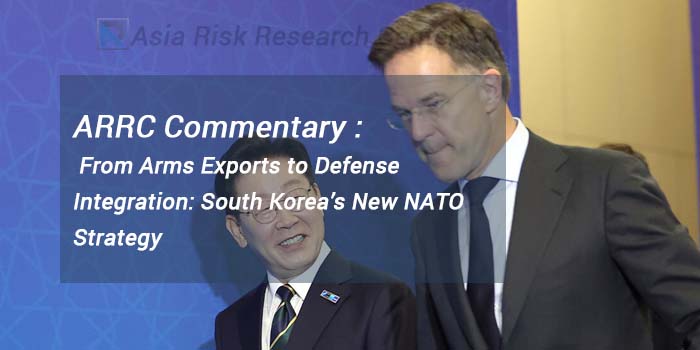
ARRC Commentary From Arms Exports to Defense Integration: South Korea’s New NATO Strategy
July 23rd, 2026
(Executive Summary)
South Korean President Lee Jae Myung used his first NATO summit, held in Ankara on 7–8 July 2026, not primarily to discuss traditional security issues but to introduce a fundamentally new vision of cooperation between South Korea and the Alliance. Rather than focusing on expanding arms exports, Seoul proposed a transition toward long-term industrial integration with NATO through joint research, co-development, manufacturing, technology sharing, and participation in common defense supply chains.
This initiative, officially presented as "Korea–NATO Defense Industry Partnership 2.0," represents more than a change in terminology. It reflects Seoul's recognition that the business model that fueled the remarkable rise of South Korea's defense industry over the past several years is approaching its natural limits. European countries are rebuilding their own military-industrial base and increasingly favor domestic production over imports. Consequently, South Korea seeks to evolve from an external supplier into an indispensable participant within NATO's broader defense ecosystem.
Why the Previous Model Worked
The Russian-Ukrainian conflict fundamentally transformed Europe's defense market. As European countries transferred large quantities of military equipment and ammunition to Ukraine, they simultaneously faced an urgent need to replenish their own stockpiles. European manufacturers were unable to rapidly expand production after decades of reduced military spending. South Korea, however, possessed several important advantages:
- mature and highly efficient defense production capabilities;
- compatibility of many systems with NATO standards;
- relatively short production cycles;
- competitive pricing;
- willingness to expand manufacturing rapidly.
This created an unprecedented opportunity for Seoul. Within only a few years, South Korea secured major contracts with Poland, Romania, Norway and several other European countries. Platforms such as the K2 main battle tank, K9 self-propelled howitzer, Chunmoo multiple rocket launcher and 155-mm artillery ammunition became symbols of South Korea's emergence as one of the world's fastest-growing defense exporters. The country's defense industry gained an international reputation as a reliable supplier capable of delivering modern weapons quickly and in large quantities.
Why Exporting Weapons Is No Longer Enough
Ironically, South Korea's own success has contributed to a changing strategic environment.
As Europe dramatically increased defense expenditures, it also began rebuilding its domestic industrial capacity. NATO European members and Canada invested approximately $574 billion in defense during 2025, while Alliance members agreed to increase defense-related spending toward 5% of GDP by 2035. At the same time, the European Union adopted policies explicitly aimed at strengthening indigenous defense production.
The EU's industrial strategy now requires:
- at least 50% of procured military equipment to be produced inside the EU by 2030;
- approximately 60% by 2035;
- under the SAFE program (€150 billion), at least 65% of production value should originate from companies based in the EU, European Economic Area or Ukraine.
For outside suppliers, including South Korea, these trends represent a significant structural challenge.
Another important signal came immediately before the NATO summit when Germany's TKMS won Canada's multibillion-dollar submarine competition despite strong expectations that South Korea had become a leading contender. Although the tender itself was not governed by EU procurement rules, it illustrated the growing political and industrial preference for suppliers already embedded within the Western defense community.
Partnership 2.0: A New Strategic Vision
President Lee's proposal seeks to adapt to these realities rather than resist them.
Instead of simply exporting finished weapons, Seoul proposes a much deeper form of cooperation:
- joint research and development;
- collaborative design of next-generation weapons;
- localized production inside NATO countries;
- joint maintenance and modernization;
- integrated supply chains;
- cooperation in artificial intelligence, robotics, space technologies, cybersecurity and autonomous systems.
In Lee's own words, modern conflicts are increasingly determined not only on battlefields but also in laboratories, research centers and production facilities. Artificial intelligence, drones, resilient supply chains and advanced manufacturing have become essential components of national security.
The emphasis therefore shifts from selling equipment to jointly creating technological capabilities.
Becoming Part of NATO's Defense Ecosystem
The core objective of Seoul's new strategy is institutional integration rather than larger export volumes. Traditional arms exports are inherently unstable: one contract may be won, the next lost. Participation in common development programs, however, creates long-term industrial relationships that are considerably more difficult to replace.
Accordingly, South Korea aims to become integrated into NATO's defense ecosystem through:
- participation in multinational R&D;
- adoption and development of NATO standards (STANAG);
- cooperation on AI, cyber technologies and space systems;
- inclusion in long-term defense supply chains;
- shared production and life-cycle support.
The strategic evolution can be summarized as follows:
Previous model: Research → Production → Export
New model: Joint Research → Joint Development → Joint Production → Joint Operation → Integrated Supply Chains → Long-Term Participation in NATO's Defense Architecture.
If implemented successfully, this approach would provide South Korean defense companies with a much stronger and more durable position within Europe's security infrastructure than even very large export contracts could achieve.
The Importance of Trust
A recurring theme throughout President Lee's speech was trust.He argued that industrial cooperation requires confidence that supply chains will remain uninterrupted even during crises and that sensitive technologies will be adequately protected. South Korea presents itself not merely as an efficient producer but as a reliable strategic partner sharing democratic values and historical ties with NATO dating back to the Korean War.
This narrative serves an important political purpose. Rather than asking NATO to open its defense market to another foreign exporter, Seoul argues that South Korea should increasingly be regarded as part of the broader community of trusted industrial partners.
Strategic Risks
The proposed strategy also creates new political challenges.
Closer defense integration with NATO inevitably raises questions about South Korea's broader geopolitical orientation. While cooperation with NATO has become more attractive because of North Korea's growing military cooperation with Russia and the continuing war in Ukraine, Seoul remains reluctant to be perceived as:
- an "Asian branch" of NATO;
- a participant in European military conflicts;
- an instrument of U.S. containment policy toward China.
South Korea seeks to preserve pragmatic relations with both Beijing and Moscow while simultaneously deepening industrial cooperation with Western partners. For this reason, many South Korean analysts emphasize that cooperation should remain concentrated in areas where interests naturally overlap—defense technology, AI, cyber security, space, unmanned systems and industrial standardization—without transforming into broader military commitments.
Nevertheless, such distinctions may not convince countries that increasingly view South Korea through the prism of NATO expansion. Russia has already criticized Seoul's growing cooperation with the Alliance. During a meeting with the South Korean ambassador on 16 July, Russian Deputy Foreign Minister Andrey Rudenko expressed concern over what Moscow described as South Korea's drift toward NATO and warned against its participation in NATO's military buildup. This reaction illustrates one of the principal dilemmas facing Seoul: while attempting to pursue primarily industrial objectives, it may increasingly be perceived as taking sides in broader geopolitical confrontations.
Outlook
The Ankara NATO summit demonstrated that South Korea is redefining the philosophy behind its defense industry. The previous strategy—accelerating arms exports to satisfy Europe's urgent wartime demand—appears to have reached its practical limits. The new approach seeks something considerably more ambitious: permanent integration into one of the world's largest defense-industrial systems.
Rather than positioning itself simply as a supplier of weapons, Seoul now aims to become a long-term technological and industrial partner through joint research, common production, shared standards and integrated supply chains. Whether this strategy ultimately succeeds remains uncertain. However, it clearly represents a significant evolution in South Korea's defense-industrial and foreign economic strategy and could transform the country's defense sector into one of the principal drivers of future technological and economic development.
Oleg Kiryanov
※ The views and opinions expressed here are solely those of the author and do not necessarily reflect the official position of the Asia Risk Research Center.
Editor's note: This is an abridged English summary of an article originally published in Russian. The full Russian version is available on the Asia Risk Research Center website.

