


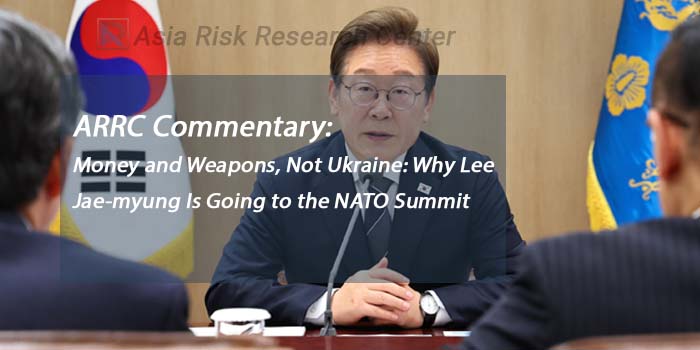
ARRC Commentary: Money and Weapons, Not Ukraine: Why Lee Jae-myung Is Going to the NATO Summit
July 6th, 2026
(Executive Summary)
South Korean President Lee Jae-myung’s participation in the upcoming NATO summit in Ankara (July 7-8th) should not be viewed primarily through the lens of Ukraine, Russia, or European security. For Seoul, the main objective is far more pragmatic: access to the world’s largest defense market, expansion of arms exports, and integration of South Korean companies into NATO’s defense production chains.
Although Western media often frame NATO summits around the war in Ukraine, South Korea sees the current moment as a major commercial and strategic opportunity. NATO countries account for roughly 55 percent of global defense spending, and Seoul wants to use their sharply rising military budgets to strengthen its own defense industry. South Korea has already become one of the fastest-growing arms exporters in the world, with major contracts in Poland, Romania, Norway, Estonia and other European states. Its weapons systems — including K2 tanks, K9 self-propelled howitzers, K239 Chunmoo rocket artillery systems and Cheongung-II air defense systems — are valued for fast delivery, competitive prices and compatibility with NATO standards.
Lee’s program in Ankara reflects this goal. He is expected to attend the NATO Defense Industry Forum, hold talks with NATO Secretary General Mark Rutte, participate in the IP4 format with Japan, Australia and New Zealand, and conduct bilateral meetings with leaders of countries interested in defense cooperation. In practical terms, the summit is not only a political event for Seoul, but also a major international marketplace for promoting South Korean weapons and defense technology.
One key task is to embed South Korean companies into NATO supply chains. Seoul is not only trying to sell finished military equipment, but also to secure participation in joint production, maintenance and weapons development programs. This would make South Korea’s position in the European market more durable and reduce the risk that European defense companies could push Korean competitors out once the war in Ukraine eventually ends.
A particularly important issue is Canada’s Canadian Patrol Submarine Project, worth around 60 billion Canadian dollars. South Korea’s Hanwha Ocean is competing with Germany’s TKMS for the contract. A possible meeting between Lee and the Canadian prime minister could provide political support for Seoul’s bid, as South Korea is lobbying hard and offering broader cooperation packages beyond the defense sector.
Security issues will also be discussed, especially drones, artificial intelligence, space technologies and new methods of warfare. Seoul is closely watching the war in Ukraine because North Korean troops’ participation on Russia’s side may give Pyongyang valuable battlefield experience. South Korea wants to learn from NATO’s experience and better understand how to counter new tactics that North Korea could absorb from Russia.
Lee is likely to support statements criticizing Moscow and backing Kyiv. However, Seoul still appears unwilling to cross the line into direct arms supplies to Ukraine, despite repeated Western pressure and strong Russian warnings. For South Korea, Ukraine is less the main purpose of the trip than an additional argument for expanding military-technological cooperation with NATO.
In short, Lee Jae-myung’s NATO visit is above all about business — military business. The war in Ukraine created a window of opportunity for South Korea’s defense industry, and Seoul intends to use it fully: to win contracts, secure long-term access to NATO markets and turn Europe’s rising defense spending into a source of industrial growth.
Oleg Kiryanov
※ The views and opinions expressed here are solely those of the author and do not necessarily reflect the official position of the Asia Risk Research Center.
Editor's note: This is an abridged English summary of an article originally published in Russian. The full Russian version is available on the Asia Risk Research Center website.

