


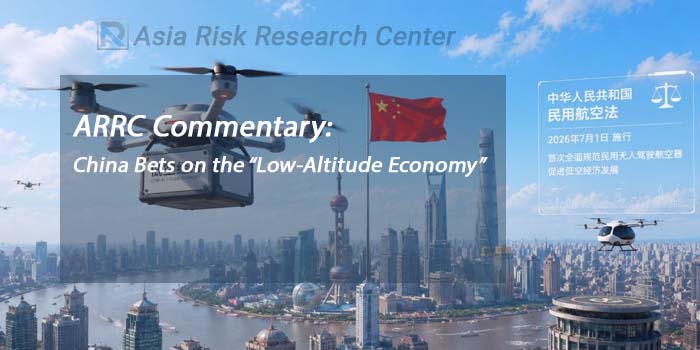
ARRC Commentary: China Bets on the “Low-Altitude Economy”
June 30th, 2026
(Executive Summary)
On July 1, 2026, the revised Civil Aviation Law of the People’s Republic of China enters into force. Adopted by the Standing Committee of the National People’s Congress in late 2025, the new version of the law marks an important regulatory turning point: for the first time, China has introduced comprehensive legal provisions covering civil unmanned aerial vehicles and has formally embedded the development of the “low-altitude economy” (低空经济) into national aviation policy.
For Beijing, this is not simply a matter of regulating drones. The low-altitude economy is being framed as a new strategic industry and a future source of economic growth. Chinese policymakers increasingly view low-altitude airspace as a new economic resource — similar in historical significance to railways, highways, seaports and, later, digital networks. The objective is to turn small aircraft, drones, eVTOL vehicles, logistics platforms and related digital infrastructure into a new ecosystem of commercial activity.
The concept of the low-altitude economy emerged in China and has rapidly moved from a technical term to an official state-level development category. It first appeared in national policy documents in 2021. By late 2023, the Central Economic Work Conference had listed it among strategic emerging industries, alongside biomanufacturing and commercial space. In 2024, the term was included for the first time in the Chinese government work report.
In most Chinese policy documents, “low altitude” refers to airspace below 1,000 meters. In some pilot zones and regional programs, however, the operating range may extend up to 3,000 meters. This reflects the fact that China’s national regulatory framework is still being formed.
The scale of the project is significant. According to the Civil Aviation Administration of China, the low-altitude economy had already exceeded 500 billion yuan, or roughly 74 billion US dollars, by the end of 2023. Chinese authorities expect the market to surpass 2 trillion yuan by 2030, while some domestic research institutions forecast further growth to 3–3.5 trillion yuan by the middle of the next decade.
The sector includes much more than drone manufacturing. It covers aircraft production, navigation systems, digital maps, communication networks, air traffic management, charging infrastructure, certification, insurance, software, logistics platforms and new urban transport services. In other words, China is attempting to create a full industrial and regulatory ecosystem around the use of low-altitude airspace.
One of the fastest-growing areas is unmanned logistics. Drones are already being used in China to deliver parcels, food, medicine and urgent supplies, especially in rural, mountainous and hard-to-reach areas. Major companies such as JD Logistics, Meituan and SF Express are expanding drone delivery services. In some locations, unmanned delivery can significantly reduce transport time and lower logistics costs.
A second major direction is the development of heavy cargo drones. Chinese manufacturers are testing unmanned aircraft capable of carrying loads ranging from several hundred kilograms to more than three tons. These aircraft are designed for remote regions, mountainous areas and islands where conventional transport infrastructure is expensive or difficult to build.
A third direction is the development of electric vertical takeoff and landing aircraft, or eVTOLs. These are expected to form the basis of future air taxi services and urban air mobility. Chinese companies such as EHang and XPeng AeroHT are already among global leaders in this field. China’s civil aviation authorities have begun issuing the necessary certificates for some models, although mass commercial use remains a task for the coming years.
A fourth major area is industrial and agricultural application. Drones are already used for crop spraying, fertilizer application, field monitoring, mapping, inspection of bridges, pipelines, power lines, forests and water systems. For a country with China’s territory, complex geography and aging rural population, such technologies can reduce costs while helping offset labor shortages.
The new Civil Aviation Law is important because large-scale adoption of drones is impossible without a functioning regulatory system. China needs rules for airspace use, aircraft registration, manufacturer and operator certification, digital identification, flight safety and emergency response. Beijing is also creating specialized state structures responsible for coordinating the development of the sector and its regulatory framework.
Southern and eastern China are currently leading the process. Guangdong Province is especially important, as it hosts DJI, the world’s largest civilian drone manufacturer, as well as EHang and many companies involved in drone logistics and low-altitude technologies. Shenzhen has introduced special support measures for next-generation aircraft developers and is aiming to become a global center of the low-altitude economy.
At the same time, the sector faces serious challenges. China must ensure flight safety, define clear airspace usage rules, build charging and maintenance infrastructure and win public trust. A significant part of China’s airspace remains restricted, which means that technological development must be accompanied by broader reform of air traffic management.
The main policy dilemma is obvious. The wider the use of drones becomes, the greater the potential economic benefit. But the more drones appear in the air, the greater the risk of accidents, collisions, technical failures or malicious use. China is therefore trying to balance control and expansion: the sector must grow quickly enough to become economically meaningful, but not so quickly that it creates safety and security risks.
For Beijing, the low-altitude economy serves several purposes at once. It creates new markets for high-tech companies, stimulates domestic demand, supports regional development, accelerates the digitalization of transport and logistics, and strengthens China’s position as a global leader in unmanned aviation. Many of the technologies involved — navigation, communication, control systems and drones themselves — also have dual-use potential and may be relevant not only for civilian but also for state and security-related applications.
China’s model is already beginning to influence other countries. Vietnam has recently announced its first regulatory sandbox for low-altitude economy projects. The scale is still far smaller than China’s, but the logic is similar: first create a special legal environment, then test different drone applications, and eventually expand successful models nationwide.
The low-altitude economy is therefore not merely a fashionable label for the drone market. In the Chinese understanding, it is a new technological and economic space. Beijing wants low-altitude airspace to become a new source of growth, just as railways, highways, ports and digital networks were in earlier phases of development.
Other countries are likely to follow this path. The potential benefits are too large to ignore: drones can make some services faster, cheaper and more accessible, especially where traditional infrastructure is expensive or inefficient. For ordinary people, this means that drones may soon become a normal part of everyday life and the service economy.
However, the risks are equally clear. A car, bus or metro train may stop working, but it will not fall from the sky onto pedestrians. Drones can. That is why the expansion of low-altitude services requires careful testing, strict safety protocols and clear procedures for emergencies. The key question is not whether drones will become part of daily life, but how safely and responsibly this transition can be managed.
Oleg Kiryanov
※ The views and opinions expressed here are solely those of the author and do not necessarily reflect the official position of the Asia Risk Research Center.
Editor's note: This is an abridged English summary of an article originally published in Russian. The full Russian version is available on the Asia Risk Research Center website.

