


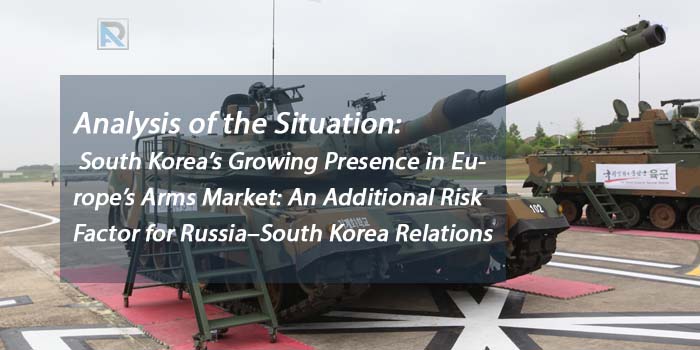
Analysis of the Situation: South Korea’s Growing Presence in Europe’s Arms Market: An Additional Risk Factor for Russia–South Korea Relations
(Executive Summary)
October 21st, 2026
South Korea has significantly strengthened its position in the European arms market in recent years, driven primarily by economic interests and its ability to capitalize on the changing geopolitical environment. Beyond securing major export contracts, Seoul is moving toward establishing defense production, maintenance, and logistics facilities in Europe, accompanied by technology transfers and localization. Combined with its expanding cooperation with NATO, these developments indicate that South Korea is becoming increasingly involved in strengthening Europe's military and defense-industrial capabilities. This trend creates additional risks for relations between Moscow and Seoul.
According to the Stockholm International Peace Research Institute (SIPRI), South Korea ranked ninth among global arms exporters in 2021–2025, accounting for 3% of international arms transfers. Poland received 58% of South Korean arms exports during this period, followed by the Philippines (18%) and the United Arab Emirates (9.5%). Meanwhile, Europe emerged as the world's largest arms-importing region, accounting for 33% of global imports, with its arms imports increasing by 210% compared with 2016–2020.
South Korea's competitive advantages include relatively affordable prices, short delivery schedules, substantial manufacturing capacity, and comprehensive procurement packages. Seoul also regards defense exports as a new driver of economic growth and aims to become one of the world's four largest arms suppliers.
Expansion into the European Defense Market
Poland has become South Korea's largest European defense customer. A framework agreement reached in July 2022, valued at approximately $44 billion, envisaged the procurement of up to 1,000 K2 tanks, 648 K9 self-propelled howitzers, 288 K239 Chunmoo multiple-launch rocket systems (MLRS), and 48 FA-50 light combat aircraft. Subsequent contracts included a $12.4 billion package in August 2022, additional K239 systems, a second K9 contract worth $2.67 billion in December 2023, and a $6.5 billion agreement for another 180 K2 tanks in August 2025. The latter also provides for maintenance, ammunition, spare parts, technology transfers, and localized production.
South Korea has concluded additional agreements with several European countries. Romania contracted for 54 K9 howitzers, 36 K10 ammunition resupply vehicles, and 54 Chiron portable air-defense systems. Norway signed agreements for additional K9 howitzers and K239 rocket systems in 2025–2026. Finland ordered 112 K9 howitzers in April 2026, while Estonia expanded its procurement of K239 systems. Spain signed an agreement for 128 K9 howitzers in August 2026, and Croatia reached an agreement concerning 18 K239 systems in September.
These transactions demonstrate that South Korea is becoming an important supplier of modern offensive weapons, particularly tanks, artillery, and long-range rocket systems, to European NATO members, including countries bordering Russia or located near its borders.
From Seoul's perspective, this expansion represents a rational pursuit of national economic interests. From Moscow's perspective, however, South Korean equipment contributes to the modernization of the armed forces of countries pursuing confrontational policies toward Russia. The resulting improvement in NATO members' military capabilities may therefore be perceived as a direct challenge to Russian security interests.
From Arms Exports to Defense-Industrial Integration
South Korea's European strategy increasingly extends beyond conventional arms exports. Korean defense manufacturers are developing production and maintenance facilities that could integrate their technologies into European defense-industrial supply chains.
Major initiatives include cooperation between Hyundai Rotem and Poland's PGZ on K2 tank production, a joint venture between Hanwha Aerospace and Poland's WB Group for K239 rockets, and a Hanwha Aerospace manufacturing facility in Romania for K9 howitzers and potentially other armored platforms. Additional ammunition production facilities are being considered in Poland and Estonia.
These projects are intended to serve not only as manufacturing centers but also as regional maintenance, repair, and logistics hubs. Their development could facilitate additional exports, improve equipment availability, and deepen long-term industrial cooperation with NATO countries, including within the framework of the European Union's Readiness 2030 strategy.
Consequently, South Korea's involvement should be understood not merely as the replenishment of individual European arsenals but as a contribution to the broader strengthening of NATO's eastern and northern flanks and the development of Europe's defense-industrial capacity.
A New Framework for South Korea–NATO Cooperation
Seoul's ambitions were further demonstrated at the 2026 NATO summit in Türkiye, where President Lee Jae-myung presented the concept of the Korea–NATO Defense Industry Partnership 2.0.
The initiative seeks to move beyond individual arms transactions toward joint research and development, manufacturing, operation, maintenance, and the creation of an interconnected defense-industrial ecosystem. Particular emphasis is placed on advanced technologies, including artificial intelligence, unmanned systems, robotics, and resilient defense supply chains.
During the summit, President Lee and NATO Secretary General Mark Rutte agreed to initiate discussions on a framework procurement agreement that would facilitate South Korean defense companies' access to procurement opportunities across NATO's 32 member states. The parties also discussed defense standardization.
South Korea additionally joined NATO's Defense Critical Raw Materials Initiative as an observer and is expected to participate in the Alliance's innovation ecosystem, including programs involving technologies developed and tested in light of the war in Ukraine.
Another important development was Hyundai Rotem's acquisition of AQAP-2110 certification, confirming compliance with NATO quality assurance requirements for defense-related design, development, and production. This strengthens the company's prospects for further expansion in the European defense market.
For Seoul, closer institutional cooperation with NATO could also help overcome European market barriers designed to protect domestic defense manufacturers.
Implications for Russia–South Korea Relations
Although South Korea's expanding defense cooperation with Europe is primarily economically motivated, its strategic implications extend beyond commercial considerations.
Moscow may interpret Seoul's growing involvement in strengthening NATO's military and industrial capabilities as a threat to Russian national interests. South Korean weapons supplied to European countries could contribute directly to their military modernization while indirectly enabling them to transfer other equipment to Ukraine.
There is also a longer-term risk that South Korean-made weapons could eventually be employed in a direct military confrontation between Russia and NATO. Seoul would have limited practical ability to prevent such use once the equipment has been transferred to European customers.
Under these circumstances, Russia could respond by expanding military-technical cooperation with North Korea, potentially including the transfer of advanced weapons and sensitive technologies. Such a response could negatively affect the security environment on the Korean Peninsula and in Northeast Asia.
Even without such escalation, South Korea's deeper integration into NATO's defense-industrial structures could accelerate the deterioration of Russia–South Korea relations. Moscow might become increasingly cautious toward future cooperation initiatives proposed by Seoul, including projects involving the Northern Sea Route.
The underlying problem is a fundamental difference in how the two countries perceive the same developments. South Korea regards arms exports and cooperation with NATO as legitimate instruments for promoting national economic and technological interests. Russia may view these activities as strengthening the military capabilities of potential adversaries and increasing security threats near its borders.
A similar divergence characterizes the two countries' assessments of Russia–North Korea military-technical cooperation, which Moscow and Seoul interpret through their respective national security priorities.
The analysis therefore concludes that South Korea's expanding presence in the European arms market and its efforts to integrate more closely with NATO's defense-industrial ecosystem constitute an additional source of tension in relations with Russia.
Avoiding further deterioration will require both Moscow and Seoul to respect established understandings and security-related red lines. For South Korea, this implies a pragmatic, balanced, and selective approach to cooperation with NATO that takes into account not only commercial opportunities but also its broader national interests, particularly stability and security on the Korean Peninsula.
Paul Cherkashin
※ The views and opinions expressed here are solely those of the author and do not necessarily reflect the official position of the Asia Risk Research Center.
Editor's note: This is an abridged English summary of an article originally published in Russian. The full Russian version is available on the Asia Risk Research Center website.

