


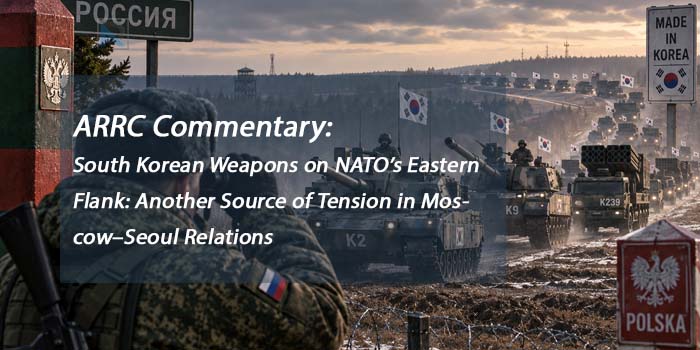
ARRC Commentary: South Korean Weapons on NATO’s Eastern Flank: Another Source of Tension in Moscow–Seoul Relations
(Executive Summary)
September 11th, 2026
South Korean-made weapons are becoming an increasingly visible component of NATO’s military capabilities on its eastern and northern flanks. K2 Black Panther tanks, K9 Thunder self-propelled howitzers and K239 Chunmoo multiple-launch rocket systems have been purchased by Poland, Norway, Finland, Estonia and other European states. From Seoul’s perspective, this represents one of the most significant export successes of its defense industry. Moscow sees the same development differently: modern South Korean weapons are being deployed close to Russian territory and are becoming part of NATO’s military infrastructure. This divergence in perception is increasingly relevant to already strained Russia–South Korea relations.
South Korean Weapons Near Russia’s Borders
Poland has emerged as the largest European customer for South Korean weapons, ordering hundreds of K2 tanks, K9 self-propelled howitzers and K239 Chunmoo launchers. Some K2s are being assigned to Poland’s 16th Pomeranian Mechanized Division, responsible for the northeastern sector bordering Russia’s Kaliningrad region and located near Belarus and the strategically important Suwałki Corridor. K9 systems and Legwan light reconnaissance vehicles based on the South Korean KLTV platform are also being deployed in northeastern Poland.
South Korean media have themselves begun highlighting the geographical implications. The local newspaper Seoul Shinmun recently described Korean weapons as being deployed “right under Putin’s nose,” an intentionally provocative formulation but one reflecting the actual proximity of some deployments to Russian territory.
The situation is particularly sensitive in Northern Europe. Norway operates K9 Vidar howitzers, including systems assigned to the new Finnmark Brigade being formed in the far north near the Russian border. Oslo is also acquiring 16 K239 Chunmoo launchers by 2030. Depending on their ammunition and deployment, such systems could potentially cover Russian military infrastructure on the Kola Peninsula and facilities associated with the Northern Fleet.
Russia has already publicly expressed concern. Russian Ambassador to Norway Nikolai Korchunov warned that Moscow considers the deployment of long-range strike systems near its borders a security threat. Finland, which shares more than 1,300 kilometers of border with Russia, is meanwhile expanding its K9 fleet, while Estonia has decided to acquire K239 Chunmoo systems in addition to U.S.-made HIMARS. South Korean weapons are consequently becoming an increasingly significant component of NATO’s land-based firepower along the Russian direction.
Why Europe Is Buying South Korean Weapons
It would be misleading to interpret South Korea’s European arms expansion as having been originally designed as an anti-Russian strategy. Its primary drivers are commercial and industrial.
Following the outbreak of the Russia–Ukraine conflict, European countries sharply increased defense spending and sought to replenish depleted inventories. European defense manufacturers proved unable to satisfy rapidly growing demand within the required timeframes. South Korea was unusually well positioned to fill the gap because decades of military confrontation with North Korea had encouraged it to maintain large-scale domestic defense production and active manufacturing lines.
South Korean companies could therefore offer European customers modern systems in substantial quantities with comparatively short delivery schedules. Poland demonstrated this advantage particularly clearly: its first major agreements were signed in the summer of 2022, and the first K2 tanks and K9 howitzers arrived by December of the same year.
Another major advantage is Seoul’s willingness to localize production and transfer technology. Poland intends not merely to import finished systems but to establish domestic production, maintenance capabilities and joint ammunition manufacturing. The relationship is therefore evolving beyond conventional arms exports toward the integration of South Korean companies into European defense-industrial supply chains. For Seoul, this provides a major strategic commercial opportunity in a rapidly expanding European defense market.
“Just Business” for Seoul, a Security Issue for Moscow
From Seoul’s perspective, its position is relatively straightforward. South Korea does not directly supply lethal weapons to Ukraine. Poland, Norway, Finland and Estonia are sovereign countries purchasing South Korean equipment for their own armed forces, while Korean manufacturers do not determine where those countries subsequently deploy it.
The European market also represents a rare opportunity for the South Korean defense industry to move to a new level. With demand measured in tens of billions of dollars and traditional Western suppliers facing production constraints, abandoning this market because Moscow objects to NATO’s military expansion would hardly be considered consistent with South Korea’s national interests. Seoul can therefore argue that it is exporting weapons to European customers in the same manner as it sells military equipment elsewhere.
Moscow evaluates the issue through a different security logic. What matters from the Russian perspective is not the formal structure of the commercial contract but its military result. A K2 tank stationed in South Korea has virtually no relevance to Russian security. The same tank assigned to a Polish unit near Kaliningrad becomes part of a fundamentally different strategic environment. Similar considerations apply to K9 howitzers in Finland and Norway and, even more significantly, to long-range Chunmoo systems.
Russia formally expressed this concern on July 16, when Deputy Foreign Minister Andrey Rudenko told South Korean Ambassador Lee Seok-bae that Moscow was seriously concerned about Seoul’s growing ties with NATO. The Russian Foreign Ministry specifically referred to expanding military and military-technical cooperation and its contribution to the alliance’s qualitative and quantitative rearmament.
Localization adds another dimension. From Moscow’s perspective, South Korea is no longer simply selling individual pieces of equipment: it is increasingly helping NATO members expand their own ability to manufacture, maintain and support modern weapons. This blurs the distinction between exporting military equipment to European states and participating in the development of their defense-industrial capabilities.
The North Korean Parallel
The contradiction becomes particularly evident when the situation is viewed from the opposite direction. Seoul strongly objects to Russian military cooperation with North Korea, particularly the possibility that Moscow could provide Pyongyang with advanced technologies or weapons that would improve North Korea’s military capabilities. From the South Korean perspective, such cooperation cannot be dismissed as ordinary cooperation because its consequences directly affect South Korea’s security.
A similar logic shapes Russia’s response to South Korean military cooperation with NATO. Moscow sees Korean weapons deployed close to its borders as contributing to the capabilities of an alliance it regards as a direct security threat.
There is insufficient evidence to describe South Korean arms exports to Europe as retaliation for closer Russia–North Korea relations. Seoul’s expansion into the European defense market began earlier and has clear independent commercial foundations. Nevertheless, Moscow–Pyongyang military cooperation inevitably affects South Korean strategic calculations and reduces political constraints on deeper cooperation with NATO. Seoul is increasingly interested not only in arms sales but also in joint research, development and production with alliance members.
This creates a self-reinforcing cycle: Moscow sees Seoul expanding military cooperation with NATO and finds additional reasons to deepen its relationship with Pyongyang; Seoul sees closer Russia–North Korea military ties and gains additional justification for strengthening cooperation with NATO. Each side’s response consequently becomes part of the other side’s rationale for further action.
Conclusion
South Korean arms exports to Europe are unlikely by themselves to trigger a separate crisis in relations with Russia. Bilateral ties had already deteriorated sharply following the outbreak of the Russia–Ukraine conflict, Seoul’s participation in sanctions against Moscow and Russia’s subsequent military-political rapprochement with North Korea.
However, the growing presence of South Korean weapons on NATO’s eastern and northern flanks adds another significant irritant. Both Moscow and Seoul can present rational national-security arguments for their respective policies while simultaneously interpreting the other side’s actions as justification for further countermeasures.
The core problem therefore extends beyond the K2, K9 or Chunmoo systems themselves. Moscow and Seoul increasingly look at the same military developments and see fundamentally different realities. For South Korea, European contracts represent legitimate commerce, industrial expansion and a major success for its defense sector. For Russia, the practical result is additional NATO military capability close to Russian territory.
No individual contract makes South Korea Russia’s adversary. Yet every additional arms agreement, localization project and expansion of military-technical cooperation with European NATO members strengthens Moscow’s perception that Seoul is becoming progressively more involved in the alliance’s military buildup. This, in turn, further complicates attempts by Russia and South Korea to halt the broader deterioration of bilateral relations.
Oleg Kiryanov
※ The views and opinions expressed here are solely those of the author and do not necessarily reflect the official position of the Asia Risk Research Center.
Editor's note: This is an abridged English summary of an article originally published in Russian. The full Russian version is available on the Asia Risk Research Center website.

