


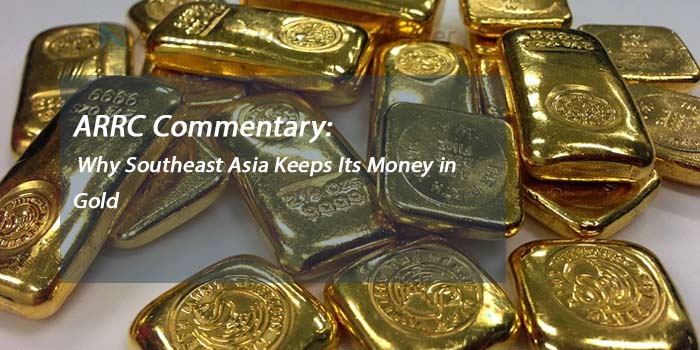
ARRC Commentary: Why Southeast Asia Keeps Its Money in Gold
(Executive Summary)
September 2nd, 2026
Despite rapid financial modernization, gold remains one of the most trusted forms of wealth across Southeast Asia. Its importance extends far beyond jewelry or traditional ceremonies. For millions of households, gold functions simultaneously as savings, an investment, emergency liquidity, collateral for loans and a hedge against economic and political instability.
Rather than disappearing with the spread of banks, securities markets and digital payments, the region’s “gold economy” is adapting to them. Physical bars and jewelry increasingly coexist with electronic gold accounts, mobile trading platforms and specialized financial products. The underlying logic, however, remains largely unchanged: gold is perceived as a tangible, liquid and reliable asset that can preserve wealth when currencies, banks or other investments become less dependable.
Why Gold Became a Form of Savings
The roots of Southeast Asia’s attachment to gold are historical, economic and cultural. Modern banking systems reached large parts of the region relatively recently. For generations, households—particularly in rural areas—needed a practical way to store surplus income from farming, trade or small businesses. Gold provided an obvious solution: it was compact, durable, divisible, widely understood and relatively easy to sell.
This created a distinctive overlap between jewelry and financial assets. A gold necklace or bracelet could serve as a display of wealth while remaining part of a family’s savings. When money was needed for illness, a wedding, home repairs or agricultural expenses, it could be sold or pledged as collateral. Gold therefore became embedded not only in household finances but also in weddings, religious celebrations, childbirth and other important social occasions.
This financial role remains particularly important for people without stable salaries, formal credit histories or assets acceptable to conventional banks. Gold is easy for a lender to authenticate, weigh and value, making it an almost universal form of collateral. Pawnshops consequently form part of the mainstream financial infrastructure in several Southeast Asian countries rather than serving only borrowers in severe financial distress. Malaysia’s Islamic Ar-Rahnu system and Indonesia’s large state-owned pawnshop operator Pegadaian illustrate how gold-backed lending has been institutionalized.
Vietnam: Gold as a Household Financial Instrument
Vietnam provides one of the clearest examples of gold’s role as an alternative savings mechanism. According to World Gold Council research cited in the analysis, 81% of surveyed Vietnamese viewed gold as protection against political and economic uncertainty, while a comparable share associated it with long-term financial security.
The Vietnamese market has developed distinctive forms of “savings gold.” Alongside traditional bullion bars, consumers buy high-purity chỉ rings. Although technically jewelry, these simple rings effectively function as investment products. They can be readily converted into cash through more than 10,000 trading outlets and can also serve as collateral for loans.
Recent market behavior demonstrates the resilience of this preference. When the Vietnamese dong weakened and alternative investments appeared unattractive, demand for bars and coins reached 26 tonnes in the first half of 2024, the highest level since 2014. Government restrictions subsequently contributed to shortages and queues at gold shops. In early 2026, investment demand declined partly because of record prices and limited supply, but consumers responded by shifting from scarce standard bars toward high-purity rings. The preferred form of gold changed; the underlying desire to keep wealth in gold did not.
Thailand and Indonesia: Modernizing the Gold Economy
Thailand illustrates a different stage of development: traditional trust in gold has evolved into a highly liquid modern investment market. Around 80% of consumer gold demand is investment-related. Physical investment increased from approximately 29 tons in 2021 to 51 tons in 2025, while jewelry demand in 2025 amounted to only about eight tones.
At the same time, more than half of Thai gold transactions are now conducted online. Banks and major dealers offer electronic accounts and mobile applications through which customers can buy and sell gold without visiting physical stores. The technology has therefore changed radically, while the investment motivation remains familiar. Thai investors also actively trade gold, selling when prices rise and buying again when they fall.
Indonesia combines an enormous potential consumer base with a similarly strong attachment to gold. A World Gold Council survey found that 67% of Indonesian investors owned gold in some form, second only to conventional bank savings at 74%. The experience of the 1997–1998 Asian financial crisis remains particularly important: the rupiah lost around 80% of its value, while gold largely preserved purchasing power when measured in local currency.
Over the past two decades, gold has generated average annual returns of approximately 15% in rupiah terms, according to the World Gold Council figures cited in the analysis. Consequently, currency weakness tends to stimulate additional demand. Investment demand remained elevated in 2025, while purchases of physical investment gold doubled quarter-on-quarter in the first quarter of 2026.
Indonesia is simultaneously integrating this traditional preference into its modern financial system. Pegadaian allows households to borrow against gold rather than permanently sell family assets, while digital platforms enable consumers to purchase very small quantities of gold. The government is also developing a more comprehensive national investment-gold trading system. Physical jewelry, bullion and smartphone-based gold ownership are therefore becoming components of the same financial ecosystem.
Common Logic, Different National Models
Five factors explain gold’s continuing strength across Southeast Asia. First is historical distrust of currencies following wars, inflation, political instability and repeated devaluations, particularly the traumatic Asian financial crisis of 1997–1998. Second is the historically uneven availability of formal banking services. Third is gold’s exceptional liquidity in countries with dense networks of dealers and pawnshops. Fourth is its cultural role: gold combines financial value with social and ceremonial significance. Finally, it is easy to understand. Unlike stocks, bonds or complex financial products, physical gold can be seen, weighed, valued and sold.
Nevertheless, Southeast Asia should not be regarded as a single homogeneous gold market. Thailand has developed one of the region’s most sophisticated and liquid retail markets. Vietnam remains heavily oriented toward physical investment gold but maintains tighter government controls over supply and imports. Indonesia combines mass domestic demand with significant domestic production. Malaysia has incorporated gold into Islamic finance, while the Philippines is an important producer but has a smaller investment market. Singapore represents a fundamentally different model: rather than a mass household gold economy, it serves as an international center for trading, refining and storage.
Laos and the Ambition to Become a Regional Gold Hub
Laos is now attempting to establish itself within this regional system. In September 2026, the government used the second Lao Gold Festival to promote its ambition to develop the country into a regional gold-trading center. The objective remains ambitious given competition from Thailand and, particularly, Singapore.
Nevertheless, some supporting infrastructure is emerging. Lao Bullion Bank was established in late 2024, while Laos and Hong Kong signed a cooperation memorandum in July 2026 aimed at developing a modern gold sector connected to international markets. Lao Bullion Bank has also begun cooperation with international precious-metals group MKS PAMP. Vientiane is therefore attempting to standardize the domestic market, expand gold-related financial services and establish stronger links with global trading centers. Whether Laos can become a significant regional hub remains uncertain, but the strategy itself demonstrates gold’s continuing economic importance in Southeast Asia.
Conclusion
The most significant development is not simply that Southeast Asia has preserved an old cultural attachment to gold. Rather, traditional gold-based saving has proved highly compatible with financial modernization.
Thailand has moved much of its gold trading onto smartphones. Indonesia allows consumers to purchase tiny digital fractions of the metal. Vietnamese households switch between bullion and high-purity rings depending on availability. Malaysia has incorporated gold collateral into Islamic finance. Governments and financial institutions are developing specialized banks, platforms and regulatory systems around an asset that households have trusted for generations.
Gold’s resilience therefore cannot be explained solely by tradition or fear of inflation. It reflects the combination of deep cultural familiarity and rational financial utility. In a region repeatedly affected by wars, currency crises and sharp devaluations, gold acquired a reputation as wealth that can survive instability. Modern technology has not displaced that perception. Instead, it has allowed an ancient savings mechanism to migrate from the family strongbox to the smartphone.
Oleg Kiryanov
※ The views and opinions expressed here are solely those of the author and do not necessarily reflect the official position of the Asia Risk Research Center.
Editor's note: This is an abridged English summary of an article originally published in Russian. The full Russian version is available on the Asia Risk Research Center website.

