


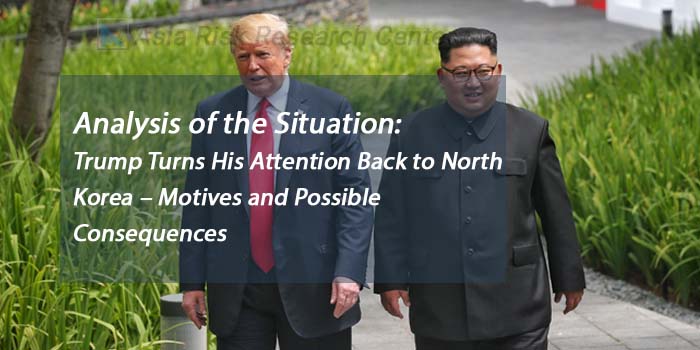
Analysis of the Situation: Trump Turns His Attention Back to North Korea – Motives and Possible Consequences
September 10th, 2026
(Executive Summary)
Since mid-August 2026, U.S. President Donald Trump has made a series of conciliatory gestures toward North Korea, signaling renewed interest in direct dialogue with Kim Jong Un. These moves appear to serve several purposes simultaneously: achieving a major foreign-policy breakthrough on the Korean Peninsula, putting additional pressure on South Korea over its security and economic commitments to the United States, and generating a new diplomatic agenda ahead of the U.S. midterm congressional elections. A rapid resumption of substantive U.S.–North Korean negotiations nevertheless remains unlikely. Pyongyang is now in a considerably stronger position than during the 2018–2019 dialogue and has little reason to rush back to the negotiating table. Over the next two years, however, significant progress cannot be ruled out if Washington is prepared to make substantial concessions and reconsider its insistence on complete denuclearization. A possible compromise could eventually lead to de facto acceptance of North Korea as a nuclear-armed state, sanctions relief, a formal end to the Korean War, and the establishment of permanent direct channels between Washington and Pyongyang.
Trump’s Signals and Pyongyang’s Response
Trump’s renewed diplomatic signaling began on August 16, when he posted a photograph of his 2019 meeting with Kim Jong Un at Panmunjom and emphasized their “very good” personal relationship. He subsequently ordered a reduction in the duration and scale of the U.S.–South Korean Ulchi Freedom Shield (UFS) exercises, arguing that they sent a “provocative and hostile signal” to North Korea and imposed excessive costs on the United States.
Pyongyang responded cautiously. Kim Yo Jong dismissed the reduction of UFS as largely irrelevant, arguing that the exercises themselves remained evidence of an unchanged hostile policy toward North Korea. At the same time, she reiterated that Kim Jong Un retained positive personal feelings and memories regarding Trump. North Korea therefore refused to treat the U.S. move as a sufficient concession while deliberately leaving room for renewed leader-level diplomacy.
Trump subsequently went further. He expressed serious interest in meeting Kim Jong Un in November during his trip to China for the APEC summit, publicly estimated North Korea’s arsenal at 57 “very powerful” nuclear warheads, and avoided identifying denuclearization as the ultimate objective of future negotiations. These statements are significant because they suggest that Trump may be prepared to consider a more pragmatic approach to North Korea’s nuclear status than Washington has traditionally pursued.
Washington’s Multiple Objectives
The first objective is North Korea itself. Trump appears genuinely interested in achieving a breakthrough that would strengthen his political legacy. With little progress in resolving the conflict in Ukraine and renewed tensions surrounding Iran, North Korea once again offers an opportunity for high-profile personal diplomacy. The reduction of UFS can therefore be interpreted as an initial unilateral gesture intended to encourage Pyongyang to respond. However, the continued implementation of the trilateral Freedom Edge exercises involving the United States, South Korea and Japan limits the practical significance of this concession.
A second objective may be pressure on South Korea. Trump’s statements on North Korea have included increasingly critical remarks about Seoul, raising concerns within the Lee Jae Myung administration that Washington and Pyongyang could resume direct negotiations while marginalizing South Korea. National Security Adviser Wi Sung-lac has explicitly stressed the need to prevent a situation in which Washington and Pyongyang negotiate “around” Seoul. South Korea therefore seeks to preserve its role as a “pacemaker” facilitating renewed U.S.–North Korean engagement.
This pressure also has immediate strategic and economic dimensions. Washington wants Seoul to contribute to U.S.-led security operations in the Strait of Hormuz. South Korea is attempting to balance alliance obligations with its desire to avoid direct involvement in hostilities, considering non-combat options such as P-8A maritime patrol aircraft, logistical support, minesweepers and unmanned mine-countermeasure systems. Iran, however, has warned that any foreign participation would be regarded as support for U.S. aggression and could have serious consequences.
Economic issues provide another source of U.S. pressure. Washington is dissatisfied with delays in implementing South Korea’s previously agreed $350 billion investment commitments. Seoul has yet to finalize the first major project, while the United States is also demanding faster cooperation in shipbuilding, Alaska LNG projects and semiconductors, as well as greater flexibility on trade and tariffs. Trump’s North Korea policy may therefore also function as leverage in his broader relationship with Seoul.
North Korea’s Stronger Negotiating Position
North Korea has little incentive to respond quickly because its strategic position has improved dramatically since Trump’s first presidency. Pyongyang has significantly expanded its nuclear arsenal and diversified its delivery systems, including ICBMs, intermediate-range ballistic missiles, tactical systems, cruise missiles and other platforms.
At the same time, North Korea has substantially expanded cooperation with Russia and restored broader interaction with China. These relationships provide additional political, military, technological and economic support and reduce Pyongyang’s dependence on an agreement with Washington. As a result, North Korea can afford to wait for additional U.S. concessions rather than accept negotiations on Washington’s previous terms.
Pyongyang is unlikely to reject dialogue outright. Its preferred strategy is instead to leave the initiative to Washington while insisting on a fundamentally different basis for future negotiations. The key requirement appears to be recognition, at least in practice, of North Korea’s status as a nuclear-armed state.
Prospects for a New U.S.–North Korea Deal
The decisive issue will therefore be Washington’s willingness to abandon the previous model centered on complete North Korean denuclearization. Trump’s recent rhetoric indicates some readiness to reconsider that approach.
A more realistic negotiating framework would focus on freezing and limiting, rather than eliminating, North Korea’s nuclear arsenal, particularly its long-range capabilities. In exchange, Washington could offer substantial relaxation or removal of UN Security Council sanctions. Such an arrangement would allow Pyongyang to preserve its core nuclear deterrent while achieving one of its principal strategic objectives: relief from the international sanctions regime.
A broader package could include a peace agreement formally ending the Korean War and the establishment of reciprocal U.S. and North Korean representative offices. These could provide permanent channels of communication and create the institutional basis for gradual political and economic normalization.
In the short term, a major diplomatic breakthrough remains improbable. In the medium term, however, Trump may represent an unusually favorable opportunity for Pyongyang to achieve strategic objectives that would be considerably harder to secure from a more conventional U.S. administration. If Washington accepts a nuclear freeze and arms limitations instead of complete denuclearization and offers meaningful sanctions relief in return, a new negotiating framework could emerge.
The ultimate outcome could amount to de facto recognition of North Korea as a nuclear-armed state, substantial weakening of the international sanctions regime, a formal end to the Korean War, and the establishment of permanent direct relations between Washington and Pyongyang. Whether such a scenario becomes possible will depend primarily on the extent to which the Trump administration is prepared to revise the fundamental assumptions of previous U.S. policy toward North Korea.
Pavel Cherkashin
※ The views and opinions expressed here are solely those of the author and do not necessarily reflect the official position of the Asia Risk Research Center.
Editor's note: This is an abridged English summary of an article originally published in Russian. The full Russian version is available on the Asia Risk Research Center website.

